Getting Started with rsdv: A Practitioner's Guide to Synthetic Data Generation
Source:vignettes/getting-started.Rmd
getting-started.RmdIntroduction
Administrative records, survey microdata, and clinical data share a common problem: the very features that make them analytically valuable — individual-level detail, rare subgroup representation, longitudinal linkage — also make them difficult to share. Data governance procedures, informed consent agreements, and privacy regulations all impose friction between the data and the analyst. Synthetic data generation addresses this by learning the statistical structure of a real dataset and using it to generate a new one whose rows are artificial but whose distributional properties approximate the original.
rsdv is an R implementation of the Synthetic Data Vault (SDV) framework (Patki,
Wedge, and Veeramachaneni 2016), bringing a Gaussian copula–based
synthesis workflow to native R. The package is designed for the applied
researcher who needs to generate a shareable analogue of a sensitive
dataset, evaluate how closely the synthetic version preserves the real
data’s distributions and correlation structure, and quantify the privacy
protection the synthesis affords. The workflow follows four steps:
describe the column types, fit the synthesizer, generate synthetic rows,
and evaluate the result.
The R Synthetic Data Ecosystem
Several R packages generate synthetic data, each rooted in a different methodological tradition.
Sequential imputation methods. synthpop
(Nowok, Raab, and Dibben 2016) is the most widely cited R synthesis
package. It generates synthetic variables one at a time, conditioning
each column on those already synthesised using parametric models or
classification and regression trees (CART). The sequential approach is
flexible and interpretable, and synthpop has mature support
for multiple-imputation inference and disclosure risk measurement. It is
widely adopted in official statistics, including within UK government
data infrastructure. Sequential CART approximates the joint distribution
column-by-column rather than modelling it as a single object — so for
high-dimensional mixed data, correlation error accumulates across
steps.
Adversarial methods. arf (Watson,
Blesch, Kapar, and Wright 2023) implements Adversarial Random Forests,
which partition the feature space into locally independent leaves by
iterating between a forest-based density estimator and a discriminator.
On tabular benchmarks it matches or outperforms deep generative models
while running roughly 100 times faster — which matters for practitioners
without GPU access. It handles mixed variable types naturally. The
package is primarily oriented toward ML researchers rather than
practitioners in regulated industries; it does not provide metadata
schemas, quality reports, or privacy metrics.
Rank-based methods. synthesizer (Van
der Loo, Statistics Netherlands) synthesises data using empirical
rank-based correlation, with a single rankcor parameter
governing the privacy-utility tradeoff. The approach is fast, handles
missing data patterns, and is appropriate for settings where a
lightweight baseline synthesis is needed. Quality metrics beyond pMSE
are not built in.
Disclosure control suites. sdcMicro
(Templ, Kowarik, and Meindl 2015) is a comprehensive toolkit for
statistical disclosure control, covering suppression, perturbation,
microaggregation, and synthesis within a unified framework used by
national statistical offices globally. Synthesis in
sdcMicro is one method among many; synthesis is not the
primary product, and the workflow is designed around disclosure risk
assessment and perturbation pipelines rather than generative
modeling.
Copula infrastructure. The copula
package (Hofert, Kojadinovic, Mächler, and Yan) is the foundational R
library for copula families including Gaussian, t, Clayton, Gumbel,
Frank, and Joe. rsdv uses copula internally
for fitting and sampling. heterocop (Tomilina, Mazo, and
Jaffrézic 2024) and GenOrd are methodologically adjacent —
both estimate Gaussian copulas for mixed discrete and continuous
variables. heterocop targets network inference;
GenOrd targets simulation.
Where rsdv fits
rsdv occupies the intersection of properties no single
existing package combines: a parametric copula model for joint
distribution preservation, first-class support for mixed variable types
(continuous, categorical, boolean), an integrated quality and privacy
evaluation report, and a tidy
metadata → fit → sample → evaluate API. The disclosure
control suites (sdcMicro, synthpop) provide
privacy metrics within their own frameworks but are not designed around
generative modelling as the primary product. rsdv’s
architecture is designed so that the Gaussian copula can be replaced by
a vine copula or a deep generative model without changing the
user-facing interface, providing a clear upgrade path as needs grow.
The Gaussian Copula: A Practitioner’s Introduction
A copula is a joint distribution that separates the behaviour of each individual variable from the way variables depend on one another. Sklar’s theorem (Sklar 1959) guarantees that any multivariate distribution can be written as a copula applied to its marginal CDFs. For synthesis, this decomposition is useful: we can estimate the dependence structure from data and then recombine it with estimated or empirical marginal distributions to generate new observations.
The Gaussian copula models dependence through a correlation matrix. The synthesis pipeline has five stages:
1. Transform to uniform. Each numerical value is
mapped to the interval (0, 1) through its fitted marginal CDF (the
probability integral transform). rsdv fits a parametric
family per column — norm, beta,
gamma, truncnorm, or uniform —
and by default (default_distribution = "auto") selects the
best-fitting family by Kolmogorov-Smirnov distance. You can override the
choice per column via numerical_distributions. Categorical
and boolean columns are mapped to (0, 1) by their cumulative-frequency
intervals (each value is placed uniformly at random within its
category’s interval), so they enter the copula too.
2. Map to normal space. The uniform values are passed through the standard normal quantile function (Φ⁻¹), yielding pseudo-observations on the real line.
3. Estimate the correlation matrix. The correlation matrix of the normal-space pseudo-observations is estimated using inversion of Kendall’s τ, a rank-based method that is more stable than maximum likelihood for small samples or tied values.
4. Sample. New pseudo-observations are drawn from the fitted multivariate normal distribution.
5. Back-transform. Numerical columns are mapped back through their fitted quantile function; categorical and boolean columns are decoded by locating which frequency interval each sampled value falls into.
Because the copula embeds every column — numerical, categorical, and boolean — it preserves cross-type dependence: numeric-vs-categorical and categorical-vs-categorical associations, not just numeric-vs-numeric correlations.
rsdv fits the copula on complete cases only; missing
values do not contribute to the dependence estimate. By default,
rsdv records the empirical missingness rate for each column
during fitting and reinstates it at sampling time. This approach models
missingness as missing completely at random (MCAR). Pre-impute
systematic missingness before synthesis — see the missing-data section
below.
Getting Started
Installation
# From CRAN:
install.packages("rsdv")

# Development version from GitHub:
remotes::install_github("kvenkita/rsdv")
A five-line synthesis
library(rsdv)

set.seed(42)

meta  <- metadata(adult_income) |>
  set_column_type("age",            "numerical")  |>
  set_column_type("education_num",  "numerical")  |>
  set_column_type("hours_per_week", "numerical")  |>
  set_column_type("occupation",     "categorical") |>
  set_column_type("income",         "categorical")

syn   <- gaussian_copula_synthesizer(meta) |> fit(adult_income)
synth <- sample(syn, n = 500)

head(synth[, c("age", "education_num", "occupation", "income")])
#>        age education_num      occupation income
#> 1 24.35615     13.218294   Other-service  <=50K
#> 2 35.55372      8.167697 Exec-managerial   >50K
#> 3 52.08036     13.917412 Farming-fishing  <=50K
#> 4 47.64983     12.725404    Adm-clerical   >50K
#> 5 32.57353     10.394470 Exec-managerial  <=50K
#> 6 65.18644      7.970632   Other-service  <=50K
Describing Your Data: The Metadata System
Every synthesis workflow begins with a column registry that tells
rsdv what each variable represents. The registry drives
everything downstream — from how columns are transformed before fitting
to what appears in the quality report.
meta <- metadata(adult_income) |>
  set_column_type("age",            "numerical")  |>
  set_column_type("education_num",  "numerical")  |>
  set_column_type("hours_per_week", "numerical")  |>
  set_column_type("occupation",     "categorical") |>
  set_column_type("marital_status", "categorical") |>
  set_column_type("income",         "categorical")

print(meta)
#> rsdv Metadata
#>   Columns: 16
#>     id [numerical]
#>     age [numerical]
#>     workclass [categorical]
#>     fnlwgt [numerical]
#>     education [categorical]
#>     education_num [numerical]
#>     marital_status [categorical]
#>     occupation [categorical]
#>     relationship [categorical]
#>     race [categorical]
#>     sex [categorical]
#>     capital_gain [numerical]
#>     capital_loss [numerical]
#>     hours_per_week [numerical]
#>     native_country [categorical]
#>     income [categorical]
Supported column types:
| Type | Description | Example columns |
|---|---|---|
"numerical" |
Continuous or discrete numeric; modelled through the copula | Age, income, test scores |
"categorical" |
Nominal or ordinal text or factor; embedded in the copula via cumulative-frequency intervals | Occupation, education level |
"boolean" |
TRUE/FALSE; embedded in the copula as a
two-level categorical |
Flag variables, binary outcomes |
"id" |
Row identifier; excluded from synthesis | Record IDs |
"datetime" |
Date or timestamp; excluded from synthesis | Survey date |
Passing a data frame to metadata() auto-detects column
types from R class — override specific types with
set_column_type().
Fitting and Sampling
set.seed(42)

syn   <- gaussian_copula_synthesizer(meta)
syn   <- fit(syn, adult_income)
synth <- sample(syn, n = 500)
synth is a data frame with 500 rows and the same six
columns as adult_income. fit() estimates one
transformer per registered column and the Gaussian copula correlation
matrix over all modeled columns (numerical, categorical, boolean) on
complete cases. sample() then draws n rows
from the fitted copula and back-transforms each column through its
estimated marginal.
Choosing marginal distributions
By default each numerical column is fit with the best of five
parametric families — norm, beta,
gamma, truncnorm, uniform —
chosen by Kolmogorov-Smirnov distance
(default_distribution = "auto"). You can pin a family
globally or per column when you have prior knowledge about a variable’s
shape:
syn_dist <- gaussian_copula_synthesizer(
  meta,
  numerical_distributions = list(capital_gain = "gamma"),
  default_distribution    = "norm"
) |>
  fit(adult_income)
Here capital_gain is modeled as gamma (a natural choice
for a skewed, non-negative quantity) while all other numerical columns
use a normal marginal.
Conditional Sampling
sample_conditions() fixes one or more categorical or
boolean columns to chosen values and draws the rest from the fitted
copula via rejection sampling. This preserves the modeled dependence
between the conditioned columns and the rest of the table.
high_earners <- sample_conditions(
  syn,
  data.frame(income = ">50K", .n = 50, stringsAsFactors = FALSE)
)
table(high_earners$income)
#>
#> >50K
#>   50
The optional .n column sets how many rows per condition
(positive integers); supply multiple rows for multiple conditions at
once. Numerical columns cannot be conditioned on — exact equality is
ill-defined for continuous values. sample_conditions() also
enforces any metadata constraints, rejecting rows that violate them just
as sample() does.
Evaluating Quality
quality_report() aggregates metrics into the
two-property hierarchy SDMetrics uses: Column Shapes
(per-column marginal fidelity) and Column Pair Trends
(pairwise dependence). The overall score is the mean of the two, so raw
column counts don’t tilt it. ML efficacy, when requested via
target_col, is reported separately and excluded from the
overall score.
qr <- quality_report(adult_income, synth, meta)
print(qr)
#> == rsdv Quality Report ==
#>
#> Column Similarity (KS, numerical):
#>   id                   0.958
#>   age                  0.948
#>   fnlwgt               0.950
#>   education_num        0.780
#>   capital_gain         0.468
#>   capital_loss         0.470
#>   hours_per_week       0.738
#>
#> Column Similarity (TVD, categorical):
#>   workclass            0.957
#>   education            0.944
#>   marital_status       0.952
#>   occupation           0.948
#>   relationship         0.978
#>   race                 0.990
#>   sex                  0.992
#>   native_country       0.973
#>   income               0.980
#>
#> Property scores:
#>   Column Shapes        0.877
#>   Column Pair Trends   0.903
#>     (correlation 0.967, contingency 0.865)
#>
#> Overall Score:               0.890
Column-level similarity
col_scores <- rbind(
  data.frame(
    column = qr$ks_scores$column,
    score  = qr$ks_scores$score,
    type   = "KS similarity\n(numerical)",
    stringsAsFactors = FALSE
  ),
  data.frame(
    column = qr$tvd_scores$column,
    score  = qr$tvd_scores$score,
    type   = "TVD similarity\n(categorical)",
    stringsAsFactors = FALSE
  )
)

ggplot2::ggplot(
  col_scores,
  ggplot2::aes(x = reorder(column, score), y = score, fill = type)
) +
  ggplot2::geom_col(width = 0.65, alpha = 0.9) +
  ggplot2::geom_text(
    ggplot2::aes(label = sprintf("%.2f", score)),
    hjust = -0.15, size = 3.2, colour = "grey30"
  ) +
  ggplot2::coord_flip() +
  ggplot2::scale_y_continuous(
    limits = c(0, 1.15),
    labels = scales::percent_format(accuracy = 1)
  ) +
  ggplot2::scale_fill_manual(
    values = c(
      "KS similarity\n(numerical)"    = "#2171b5",
      "TVD similarity\n(categorical)" = "#238b45"
    )
  ) +
  ggplot2::labs(
    title    = "Column Similarity: Real vs. Synthetic",
    subtitle = sprintf("Overall quality score: %.3f", qr$overall_score),
    x        = NULL,
    y        = "Similarity score",
    fill     = NULL
  ) +
  ggplot2::theme_minimal(base_size = 11) +
  ggplot2::theme(
    legend.position    = "bottom",
    panel.grid.major.y = ggplot2::element_blank(),
    plot.title         = ggplot2::element_text(face = "bold"),
    plot.subtitle      = ggplot2::element_text(colour = "grey40")
  )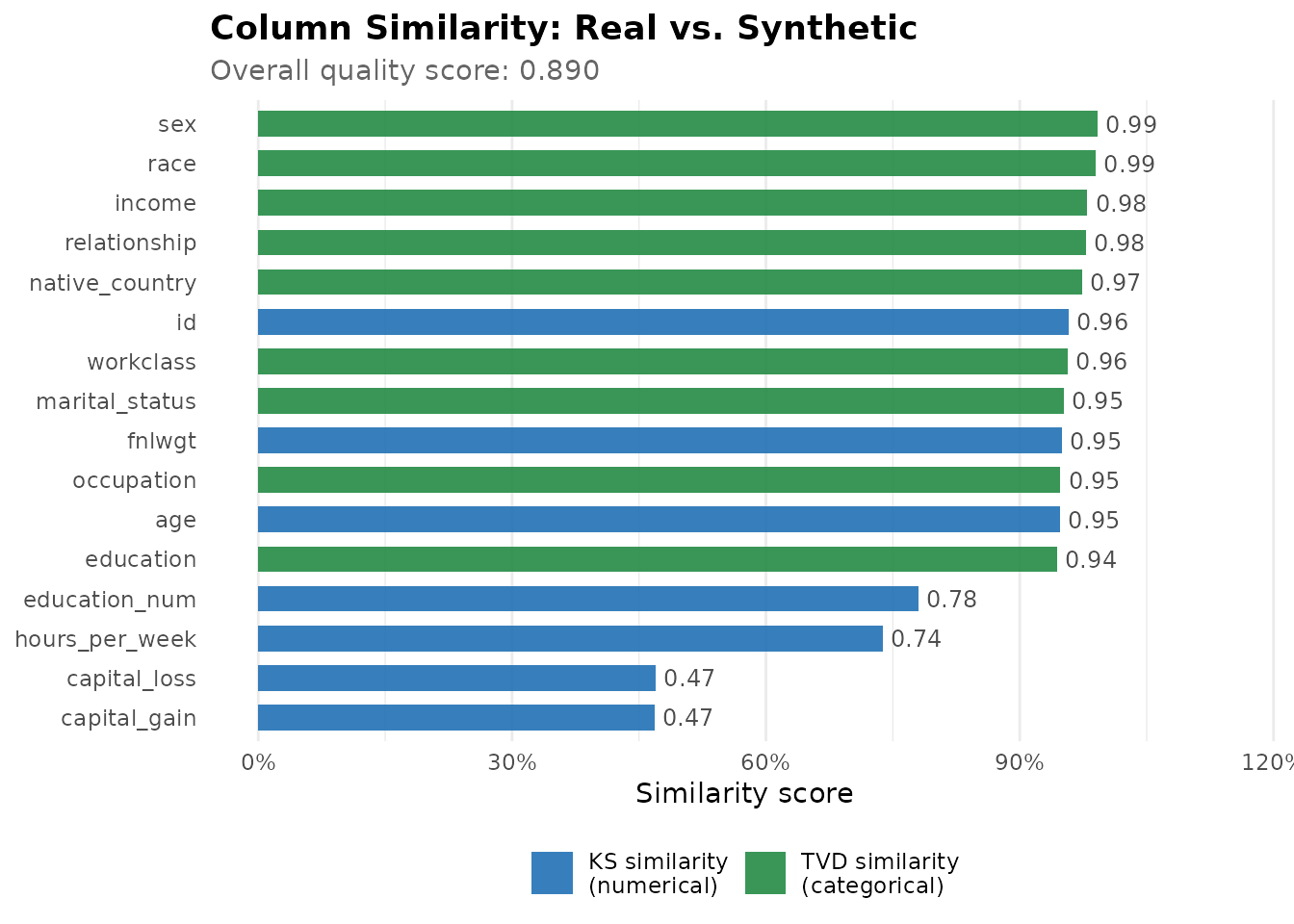
Kolmogorov-Smirnov (KS) similarity measures the maximum absolute difference between the empirical CDFs of a numerical column in the real and synthetic datasets, scored 0–1 (1 = identical distributions). Total variation distance (TVD) similarity is the analogous measure for categorical columns: it computes the maximum difference in probability mass between the real and synthetic frequency distributions, on the same scale. Together they form the Column Shapes property.
The Column Pair Trends property captures pairwise
dependence: correlation similarity
(1 - |corr_real - corr_syn| / 2, averaged over numerical
pairs) and contingency similarity (1 - TVD
between the joint distributions of each categorical pair). Inspect them
with correlation_similarity() and
contingency_similarity() — each returns per-pair scores
alongside the mean.
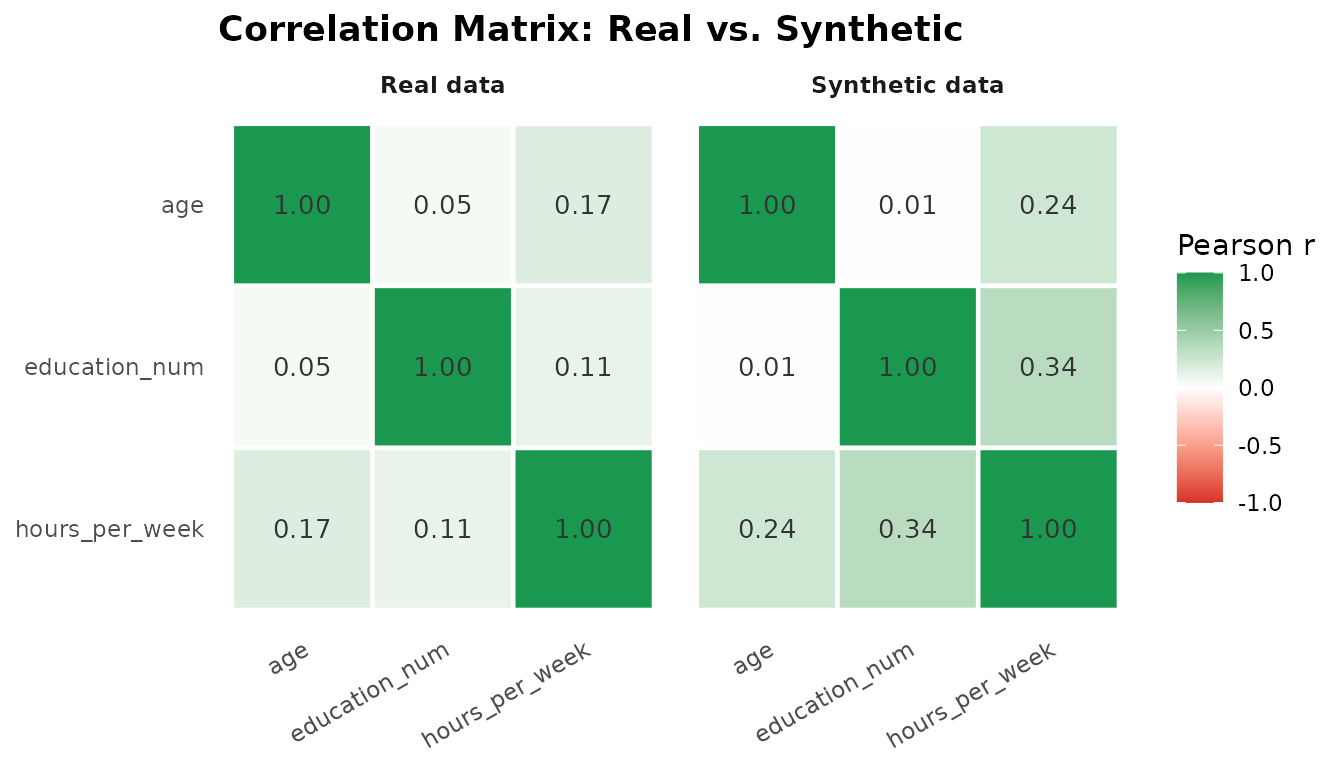
Correlation structure
The Gaussian copula’s primary purpose is to preserve inter-column correlation; the heatmaps below compare the Pearson correlation matrices for the numerical columns in real and synthetic data.
num_cols <- c("age", "education_num", "hours_per_week")

cor_real <- round(cor(adult_income[, num_cols], use = "complete.obs"), 3)
cor_syn  <- round(cor(synth[, num_cols],        use = "complete.obs"), 3)

mat_to_long <- function(mat, source) {
  nms <- colnames(mat)
  data.frame(
    var1   = rep(nms, each  = length(nms)),
    var2   = rep(nms, times = length(nms)),
    value  = as.vector(mat),
    source = source,
    stringsAsFactors = FALSE
  )
}

cor_long <- rbind(
  mat_to_long(cor_real, "Real data"),
  mat_to_long(cor_syn,  "Synthetic data")
)
cor_long$var1 <- factor(cor_long$var1, levels = rev(num_cols))
cor_long$var2 <- factor(cor_long$var2, levels = num_cols)

ggplot2::ggplot(cor_long, ggplot2::aes(var2, var1, fill = value)) +
  ggplot2::geom_tile(colour = "white", linewidth = 0.8) +
  ggplot2::geom_text(
    ggplot2::aes(label = sprintf("%.2f", value)),
    size = 3.5, colour = "grey20"
  ) +
  ggplot2::facet_wrap(~source) +
  ggplot2::scale_fill_gradient2(
    low      = "#d73027",
    mid      = "white",
    high     = "#1a9850",
    midpoint = 0,
    limits   = c(-1, 1),
    name     = "Pearson r"
  ) +
  ggplot2::labs(
    title = "Correlation Matrix: Real vs. Synthetic",
    x = NULL, y = NULL
  ) +
  ggplot2::theme_minimal(base_size = 11) +
  ggplot2::theme(
    axis.text.x     = ggplot2::element_text(angle = 30, hjust = 1),
    strip.text      = ggplot2::element_text(face = "bold"),
    legend.position = "right",
    plot.title      = ggplot2::element_text(face = "bold"),
    panel.grid      = ggplot2::element_blank()
  )
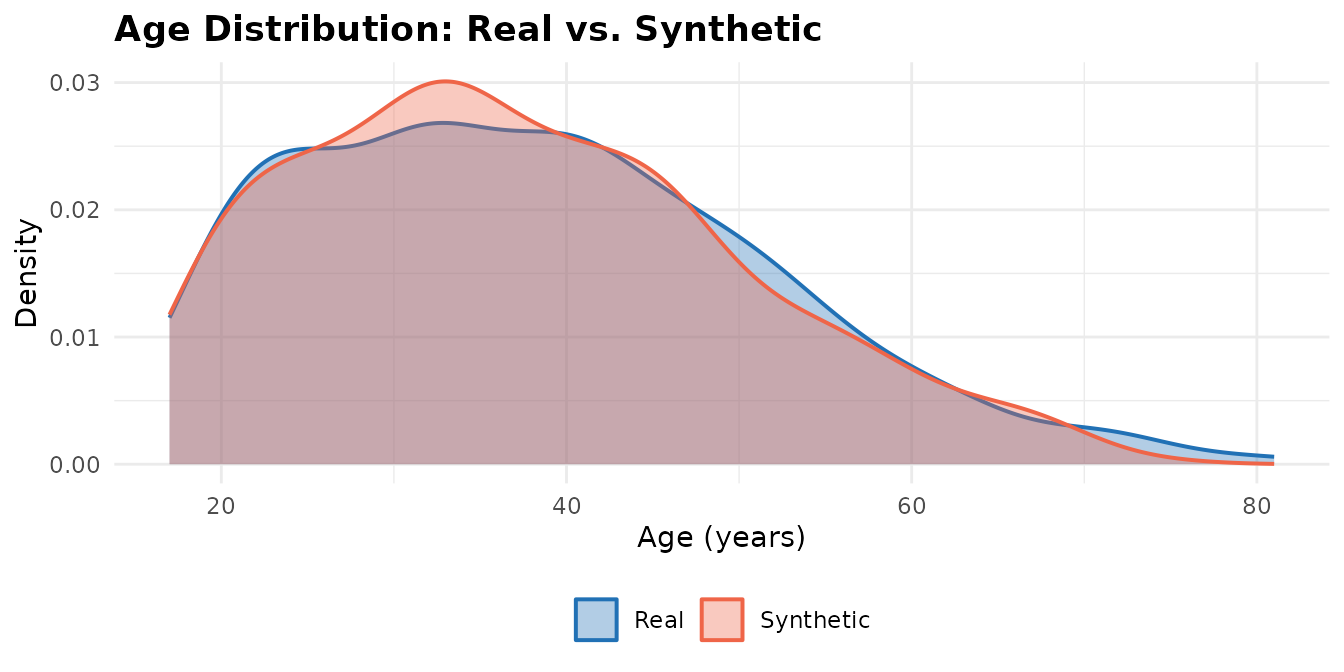
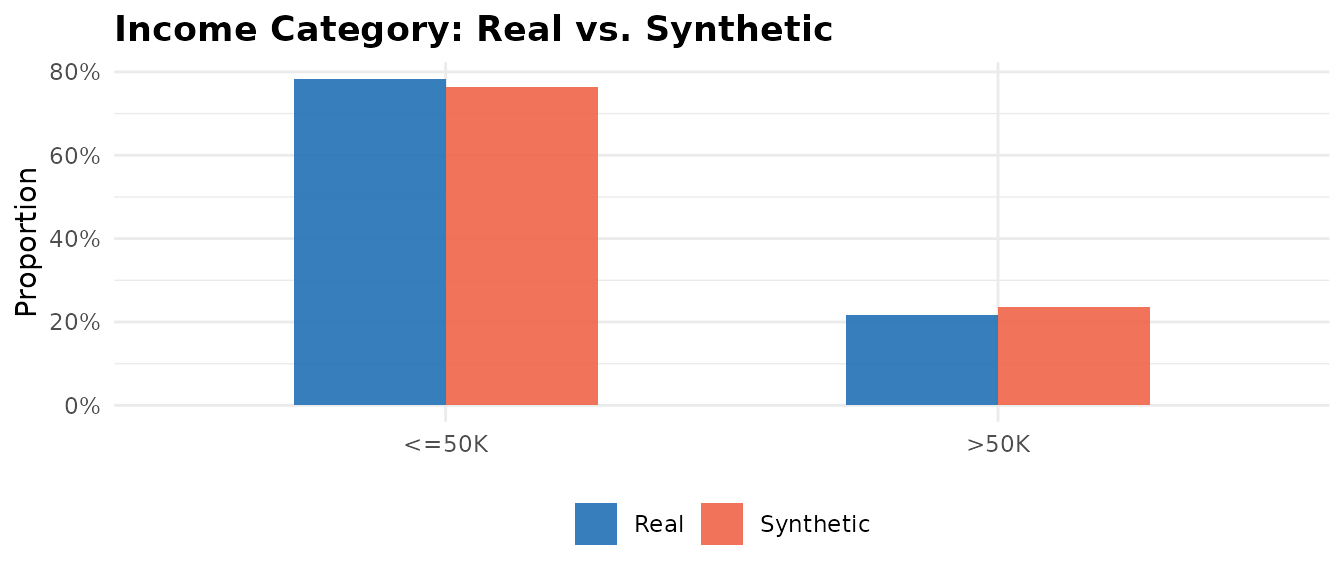
Marginal distributions
Overlaid density curves compare synthetic and real marginals directly.
age_data <- rbind(
  data.frame(value = adult_income$age, source = "Real"),
  data.frame(value = synth$age,        source = "Synthetic")
)

ggplot2::ggplot(age_data, ggplot2::aes(x = value, fill = source, colour = source)) +
  ggplot2::geom_density(alpha = 0.35, linewidth = 0.7) +
  ggplot2::scale_fill_manual(values   = c("Real" = "#2171b5", "Synthetic" = "#ef6548")) +
  ggplot2::scale_colour_manual(values = c("Real" = "#2171b5", "Synthetic" = "#ef6548")) +
  ggplot2::labs(
    title  = "Age Distribution: Real vs. Synthetic",
    x      = "Age (years)", y = "Density",
    fill   = NULL, colour = NULL
  ) +
  ggplot2::theme_minimal(base_size = 11) +
  ggplot2::theme(
    legend.position = "bottom",
    plot.title      = ggplot2::element_text(face = "bold")
  )
income_real  <- as.data.frame(table(adult_income$income) / nrow(adult_income))
income_synth <- as.data.frame(table(synth$income)        / nrow(synth))
names(income_real)  <- c("category", "proportion")
names(income_synth) <- c("category", "proportion")
income_real$source  <- "Real"
income_synth$source <- "Synthetic"
income_data <- rbind(income_real, income_synth)

ggplot2::ggplot(
  income_data,
  ggplot2::aes(x = category, y = proportion, fill = source)
) +
  ggplot2::geom_col(position = "dodge", width = 0.55, alpha = 0.9) +
  ggplot2::scale_y_continuous(labels = scales::percent_format(accuracy = 1)) +
  ggplot2::scale_fill_manual(values = c("Real" = "#2171b5", "Synthetic" = "#ef6548")) +
  ggplot2::labs(
    title = "Income Category: Real vs. Synthetic",
    x = NULL, y = "Proportion", fill = NULL
  ) +
  ggplot2::theme_minimal(base_size = 11) +
  ggplot2::theme(
    legend.position = "bottom",
    plot.title      = ggplot2::element_text(face = "bold")
  )
Diagnostic checks
Where the quality report measures how closely synthetic data resembles the real data, the diagnostic report checks whether it is structurally valid — independent of distributional fidelity. It verifies three things: that numerical values fall within the observed range (boundary adherence), that categorical values use only seen categories (category adherence), and that any primary key is unique and complete (key uniqueness). The package rolls these into a Data Validity score alongside a Data Structure score for column coverage.
dr <- diagnostic_report(adult_income, synth, meta)
print(dr)
#> == rsdv Diagnostic Report ==
#>
#> Data Validity (per column):
#>   id                   boundary adherence   1.000
#>   age                  boundary adherence   1.000
#>   fnlwgt               boundary adherence   1.000
#>   education_num        boundary adherence   1.000
#>   capital_gain         boundary adherence   1.000
#>   capital_loss         boundary adherence   1.000
#>   hours_per_week       boundary adherence   1.000
#>   workclass            category adherence   1.000
#>   education            category adherence   1.000
#>   marital_status       category adherence   1.000
#>   occupation           category adherence   1.000
#>   relationship         category adherence   1.000
#>   race                 category adherence   1.000
#>   sex                  category adherence   1.000
#>   native_country       category adherence   1.000
#>   income               category adherence   1.000
#>
#> Data Validity score:   1.000
#> Data Structure score:  1.000
#>
#> Overall Score:         1.000
Trust the quality scores only after the diagnostic passes (scores at or near 1) — structurally invalid data cannot be high-quality, no matter how the marginals look.
Evaluating Privacy
pr <- privacy_report(adult_income, synth)
print(pr)
#> == rsdv Privacy Report ==
#>
#> NNDR Score (higher = more private):  0.990
score_val <- pr$nndr_score

zones <- data.frame(
  xmin  = c(0,    0.25, 0.50, 0.75),
  xmax  = c(0.25, 0.50, 0.75, 1.00),
  ymid  = 0.5,
  label = c("High risk", "Moderate", "Good", "Excellent"),
  fill  = c("#d73027",   "#fee090",  "#a6d96a", "#1a9850"),
  stringsAsFactors = FALSE
)

ggplot2::ggplot() +
  ggplot2::geom_rect(
    data = zones,
    ggplot2::aes(xmin = xmin, xmax = xmax, ymin = 0, ymax = 1, fill = fill),
    alpha = 0.35
  ) +
  ggplot2::geom_text(
    data = zones,
    ggplot2::aes(x = (xmin + xmax) / 2, y = 0.15, label = label),
    size = 3, colour = "grey30"
  ) +
  ggplot2::geom_segment(
    data = data.frame(x = score_val),
    ggplot2::aes(x = x, xend = x, y = 0, yend = 1),
    colour = "black", linewidth = 1.6
  ) +
  ggplot2::geom_label(
    data = data.frame(x = score_val),
    ggplot2::aes(x = x, y = 0.72,
                 label = sprintf("NNDR = %.3f", x)),
    hjust = -0.08, size = 3.8, fontface = "bold",
    fill = "white", label.size = 0
  ) +
  ggplot2::scale_fill_identity() +
  ggplot2::scale_x_continuous(
    limits = c(0, 1),
    labels = scales::percent_format(accuracy = 1),
    expand = c(0, 0)
  ) +
  ggplot2::labs(
    title    = "Privacy Score: Nearest-Neighbour Distance Ratio (NNDR)",
    subtitle = "Higher score = lower re-identification risk",
    x = "NNDR score", y = NULL
  ) +
  ggplot2::theme_minimal(base_size = 11) +
  ggplot2::theme(
    axis.text.y      = ggplot2::element_blank(),
    axis.ticks.y     = ggplot2::element_blank(),
    panel.grid       = ggplot2::element_blank(),
    plot.title       = ggplot2::element_text(face = "bold"),
    plot.subtitle    = ggplot2::element_text(colour = "grey40")
  )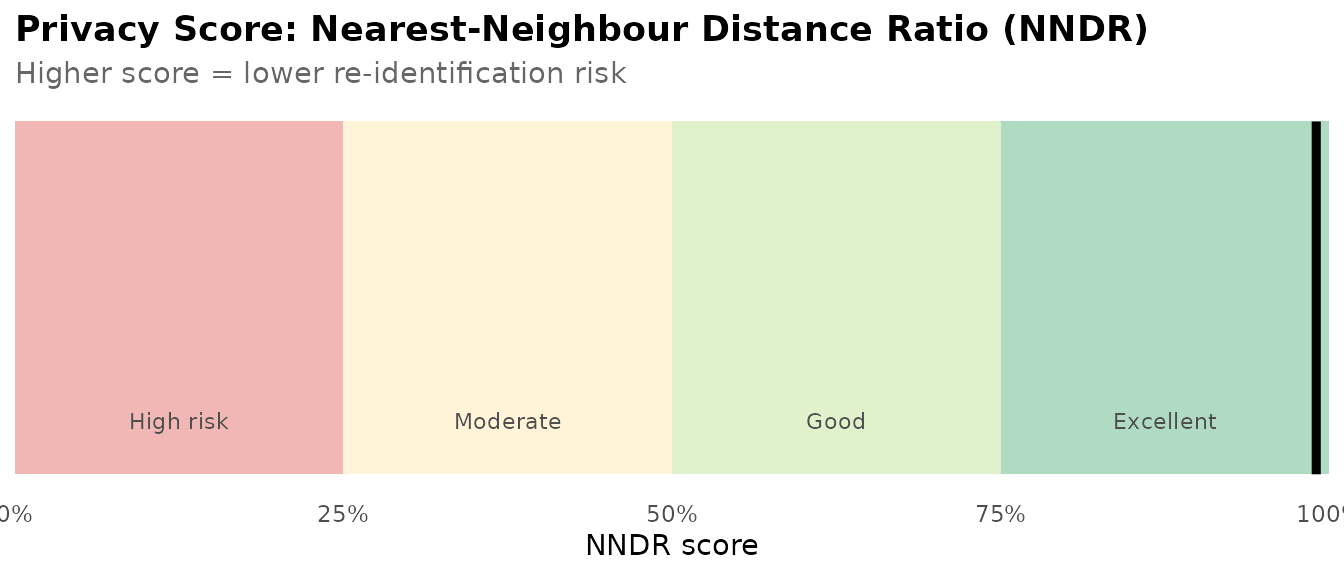
The Nearest-Neighbour Distance Ratio (NNDR) compares each synthetic row’s distance to its nearest real neighbour against its distance to its second-nearest. A high NNDR (near 1) means no synthetic row is suspiciously close to any one real record — the hallmark of low re-identification risk. A score below 0.5 suggests the synthesis is memorising real rows rather than learning the distribution.
By default nndr() z-scores each numerical column using
the real-data mean and standard deviation before computing the Euclidean
distance. Without this step, a single large-scale column — income in
dollars, for instance — dominates the distance and the score moves with
units rather than similarity. Pass normalize = FALSE to opt
out.
For attribute disclosure risk — estimating how easily a known set of
background variables can be used to infer a sensitive value — use
attribute_disclosure_risk():
adr <- attribute_disclosure_risk(
  real          = adult_income,
  synthetic     = synth,
  sensitive_col = "income",
  known_cols    = "age"
)
cat("Attribute disclosure risk (income given age):", round(adr, 3), "\n")
#> Attribute disclosure risk (income given age): 0.636
Adding Constraints
Constraints enforce domain-knowledge rules the copula model alone
will not guarantee. The system uses rejection sampling:
rsdv discards rows that fail any constraint and draws
replacements until n valid rows are collected.
meta_constrained <- meta |>
  add_constraint(
    inequality_constraint("education_num", "hours_per_week", type = "lt")
  )

syn_c   <- gaussian_copula_synthesizer(meta_constrained) |> fit(adult_income)
synth_c <- sample(syn_c, n = 500)

# Verify: education_num < hours_per_week in all rows — should return TRUE
all(synth_c$education_num < synth_c$hours_per_week)
#> [1] TRUE
Available constraint types:
| Function | Condition enforced |
|---|---|
equality_constraint(a, b, tolerance = 0) |
a == b row-wise (or
abs(a - b) <= tolerance for numerics when
tolerance > 0) |
inequality_constraint(a, b, type) |
a < b, a <= b,
a > b, or a >= b
|
fixed_combinations_constraint(cols, ref) |
Only combinations present in ref are permitted |
custom_constraint(fn, vectorized = FALSE) |
Arbitrary predicate; with vectorized = TRUE,
fn is called once on the whole data frame for a substantial
speedup |
For continuous numerical columns, exact == almost never
holds — use the tolerance argument on
equality_constraint() (or a tight band of
inequality_constraint()s). Rows containing NA
fail equality and inequality checks, so the sampler rejects them instead
of producing phantom NA rows.
Handling Missing Data
What rsdv does by default
When a column contains NA values in the training data,
rsdv records the empirical missingness rate and reproduces
it in synthetic output by randomly assigning NA to the same
proportion of rows at sampling time. The copula is fitted on complete
cases only.
This behaviour is appropriate when data are missing completely at random (MCAR) — that is, when the probability that a value is missing is unrelated to the value itself or to any other observed variable. Survey item non-response caused by form layout errors, laboratory equipment failures on random days, or random attrition in a longitudinal study are plausible examples.
When to pre-impute
Two mechanisms produce missingness patterns that MCAR-based synthesis handles poorly:
Missing at random (MAR): the probability of missingness depends on other observed variables. Income non-response that is higher among older respondents, or laboratory values missing because a clinician ordered fewer tests for healthier patients, are MAR. The copula captures conditional distributions among observed values correctly but does not model the relationship between missingness and its predictors.
Missing not at random (MNAR): the probability of missingness depends on the unobserved value itself. High earners declining to report income, or patients with the worst prognosis dropping out of a trial, are MNAR. No synthesis method fully recovers from MNAR without auxiliary information.
For MAR data, pre-imputation before synthesis is recommended:
# Pre-impute systematically missing data before synthesis
library(mice)
imputed <- complete(mice(your_data, m = 1, printFlag = FALSE))
syn <- gaussian_copula_synthesizer(meta) |> fit(imputed) |> sample(n = 500)
The missRanger package provides a fast random
forest–based alternative suitable for larger datasets.
Considerations and Caveats
Sample size. Gaussian copula estimation is stable for datasets with at least a few dozen rows per numerical dimension. The package uses Kendall’s τ–based correlation estimation, which is more robust than maximum likelihood for small samples, but correlation estimates become noisy when the number of rows is small relative to the number of numerical columns. A dataset with 3 numerical columns and 100 rows is well-conditioned; the same 100 rows with 15 numerical columns is not.
When a categorical column has more unique levels than the synthetic
sample size, some levels will be absent from the synthetic output —
expected sampling behaviour. If level coverage matters, increase
n or aggregate rare levels before synthesis.
Unsupported column types. Columns typed as
"id" or "datetime" are excluded from synthesis
and will not appear in synthetic output. fit() emits a
warning listing excluded columns. A common workaround is to convert date
variables to numeric before synthesis and convert them back
afterward.
The Gaussian copula assumes elliptical (roughly symmetric) dependence. It will underrepresent tail dependence — situations where extreme values in one variable coincide with extreme values in another, which is common in financial returns, insurance claims, and natural disaster data. For heavy-tailed dependence structures, a t-copula or vine copula extension is more appropriate.
Categorical and boolean columns are embedded in the copula via their
cumulative-frequency intervals, so associations between categorical
columns — and between categorical and numerical columns — are preserved.
Because the embedding is rank-based and the latent dependence is
Gaussian, very fine-grained or strongly non-monotone categorical
associations may be modeled only approximately; the
contingency_similarity() metric reports how well
categorical pair associations are reproduced.
Synthesis reduces re-identification risk but does not eliminate it.
The NNDR and attribute disclosure risk metrics in rsdv
provide quantitative estimates of residual risk. Use the built-in
privacy report as a starting point, and consult your institution’s data
governance office for a formal privacy impact assessment in regulated
environments.
Citation
If you use rsdv in published research, please cite the
package:
@Manual{Venkitasubramanian2026rsdv,
  title  = {{rsdv}: Synthetic Tabular Data Generation with Gaussian Copulas},
  author = {Venkitasubramanian, Kailas},
  year   = {2026},
  note   = {R package version 0.2.0},
  url    = {https://CRAN.R-project.org/package=rsdv},
  doi    = {10.32614/CRAN.package.rsdv}
}
You can also retrieve the citation from within R:
citation("rsdv")Contact and feedback: Questions, bug reports, and feature requests are welcome at kvenkita@charlotte.edu or via the GitHub issue tracker.
Copyright © 2026 Kailas Venkitasubramanian. Released under the MIT License.
References
Hofert, M., Kojadinovic, I., Mächler, M., and Yan, J. (2018).
Elements of Copula Modeling with R. Springer. (See also: R
package copula, https://cran.r-project.org/package=copula.)
Nowok, B., Raab, G. M., and Dibben, C. (2016). synthpop: Bespoke creation of synthetic data in R. Journal of Statistical Software, 74(11), 1–26. DOI:10.18637/jss.v074.i11. https://www.jstatsoft.org/article/view/v074i11.
Patki, N., Wedge, R., and Veeramachaneni, K. (2016). The synthetic data vault. IEEE International Symposium on Data Science and Advanced Analytics (DSAA), 399–410. DOI:10.1109/DSAA.2016.49. https://ieeexplore.ieee.org/document/7796926/.
Raab, G. M., Nowok, B., and Dibben, C. (2024). Practical privacy metrics for synthetic data. arXiv:2406.16826. https://arxiv.org/abs/2406.16826.
Sklar, A. (1959). Fonctions de répartition à n dimensions et leurs marges. Publications de l’Institut de Statistique de l’Université de Paris, 8, 229–231.
Templ, M., Kowarik, A., and Meindl, B. (2015). Statistical disclosure control for micro-data using the R package sdcMicro. Journal of Statistical Software, 67(4), 1–36. DOI:10.18637/jss.v067.i04.
Tomilina, G., Mazo, G., and Jaffrézic, F. (2024). A semi-parametric Gaussian copula model for heterogeneous network inference: an application to multi-omics data. HAL preprint hal-04847648. https://hal.inrae.fr/hal-04847648.
Watson, D. S., Blesch, K., Kapar, J., and Wright, M. N. (2023). Adversarial random forests for density estimation and generative modeling. Proceedings of the 26th International Conference on Artificial Intelligence and Statistics (AISTATS), PMLR 206:5357–5375. https://proceedings.mlr.press/v206/watson23a.html.